Author: Mike FineOpening Remarks Learning in science begins in early childhood. This is a time when young minds are curious about science and ready to engage in the practices and language of science that form a foundation to be built upon and strengthened throughout a student’s K–12 education. If science is not taught in elementary school, this has a major impact on their learning as they progress from one grade level to the next. Elementary students should be encouraged to make observations, ask questions, and generally wonder about things they see and notice every day. Additionally, students should be working with multiple sources of information and building ideas through conversations and activities with classmates. Ignoring these ideas and delaying the development of science language and practices until students formally encounter science in middle school certainly violates what we know about systems: If one part is missing, it affects the other parts of the system. “Something may not work as well (or at all) if a part of it is missing, broken, worn out, mismatched, or misconnected.” —(AAAS 1994, p. 264). What does the research suggest? Starting in early childhood, children are capable of learning sophisticated science and engineering concepts and engage in disciplinary practices. They are deeply curious about the world around them and eager to investigate the many questions they have about their environment. Educators can develop learning environments that support the development and demonstration of proficiencies in science and engineering, including making connections across the contexts of learning, which can help children see their ideas, interests, and practices as meaningful not just for school, but also in their lives. Unfortunately, in many preschool and elementary schools science gets relatively little attention compared to English language arts and mathematics. In addition, many early childhood and elementary teachers do not have extensive grounding in science and engineering content. Source: National Academies of Science●Engineering●Medicine “Science and Engineering in Preschool Through Elementary Grades: The Brilliance of Children and the Strengths of Educators” 2021.  LJApril15WebFieldReportsB. (2016, April 27). [Photo]. Library Journal Preschool STEM Lab | Field Reports | Library Journal. https://s3.amazonaws.com/ArchiveImages/LJ/2016/04/LJApril15WebFieldReportsB.jpg
1 Comment
Author: Colin CostelloWhy is talk important? Involving students actively in science via talk is critically important. It provides a window into students' thinking, helping us see what students do and do not understand. As students begin to talk about something, both students and teachers are able to realize if they do or do not understand everything about the topic. Ever have a student stop midway through an answer or retract their statement? Had a handful of students with competing ideas? A student provides their answer, but can’t justify it with evidence or reasoning? All of these are examples of how talk allows teachers to constantly assess our students in a formative manner. Not only that, but talk guides students into using the science practices, like constructing explanations and arguing from evidence, while encouraging them to use reasoning. This is why student discourse is such an important feature of Phenomenal Science lessons. But not all talk is equal. I-R-E (initiation, response, evaluation) is the dominant discourse pattern of classroom interactions. The student answers the teacher’s question, the teacher congratulates them on a correct response or tries another student to get the “right answer”, and the lesson moves on. In order to engage students in deep thinking with the science and engineering practices, they need access to and experience with discourse-rich sensemaking discussions. Breaking the I-R-E pattern and integrating productive talk may take time and effort to shift away from. To do this, we need to be intentional about how we set up the culture of talk in our classrooms, the tasks we engage students in, and the strategies we use to facilitate students toward more academically productive talk. Setting up a culture of talk If we want students to participate in discourse, then we need to set up an environment where they feel their ideas are valued. Are students sharing their ideas equitably? Are students asking questions of one another? Are they building on each others’ ideas? If these are the types of conversations we want happening in our classrooms, then it is imperative that we lay the groundwork for a culture of talk in our classrooms. Just like we set norms and expectations in our classrooms for behavior and routines, we need to be explicit about what we want from our students regarding discussions and talk with one another. What sort of norms or expectations would you have for your students to establish a culture of productive academic discourse? Here are some examples of norms and expectations from the Inquiry Project. Don’t forget to reinforce and revisit the expectations with your students in order to continue fostering a culture of talk throughout the year. How would you go about setting up a culture that holds students accountable for providing their thinking and building on one another’s ideas, but in a safe and equitable manner? Selecting or designing tasks worthy of student discourse Once students feel comfortable talking in your classroom, the next step is to be purposeful about what tasks are going to actually support student discourse. Just like not all student conversations are equally important, not all tasks are supportive of deep student discourse, and not all activities should necessarily require it either. Let’s use the comparisons of task A and task B from the book “5 Practices for Orchestrating Task-Based Discussion in the Science Classroom”. In the images below, notice how task A tells the student precisely what to do and how to do it. What do you think the result would be for each group of students in your class? All the same products with very little difference. Contrast task A with task B, where the task is much more open-ended, allowing students to have choice and voice, along with multiple possible ways to show their thinking. Which one would spark questions, noticings, and a deeper sense-making discussion on the topic? In order to encourage the type of discourse we want students to engage in, we need to select and design tasks that are complex with just enough ambiguity that students need to do some heavy lifting and make choices. Allow them to make sense of the situation and be the scientist trying to figure it out.
Cartier, Jennifer L. (2013). 5 practices for orchestrating productive task-based discussions in science. Reston, VA :National Council of Teachers of Mathematics : NSTA Press Teacher strategies for promoting student discourse Lastly, how do we as facilitators of this discourse make sure students are actually talking productively and moving toward understanding? How do we make sure students are building on each other’s ideas or refuting them respectfully with evidence? How do we get the discussion to a class consensus? For that, we need to employ teacher talk moves and strategies. Check out some of the Inquiry Projects talk strategies (p.7-9) and talk moves (p.11) to get some ideas. The Inquiry Project provides many resources related to talking in science and gives a nice overview of various talk moves we can do to support deeper student thinking. This takes time and practice to implement well. Maybe print out a quick reference talk moves bookmark, like this one, or the picture below, to have handy during class discussions until it becomes more natural.  Keeley, P. (2016). Formative Assessment Probes: Talk Moves. A Formative Assessment Strategy for Fostering Productive Probe Discussions. Science and Children, 53, 24-26. Want to know more about productive discourse in the classroom? Check out our other blog on this topic with additional resources.
Phenomenal Science are phenomena-based elementary science units, that integrate engineering, math, and language arts. Of course, phenomena-based means there is a critical emphasis on students making sense of phenomena, which requires them to engage in hands-on investigation, discourse, modeling, argumentation, and explanation. The phenomena-based instructional model can be hard to engage students in within the current constraints and challenges of teaching science today in our often remote-learning world. Remote or hybrid learning appears to be quite at odds with phenomena-based instruction. Since we are committed to enabling all elementary students the opportunity to engage in sense-making around real scientific phenomena, we are pleased to be working collaboratively with the Center for Digital Curricula, College of Engineering, University of Michigan. Together, we are thrilled to announce that that six PS units, cast as visual, interactive Roadmaps and hosted on the Center’s Collabrify Roadmap Platform, are now available for download and classroom use. As a digital version of the PS Units, the Roadmaps bring the units alive in the digital world and, allow for a variety of teaching styles and customizations to better meet the needs of your students. The Collabrify Roadmap Platform is browser-based (e.g., Chrome, Safari). Thus, the Platform runs on Chromebooks, Windows or Mac laptops, desktops or tablets   The Roadmaps are a digital option for the PS units that enable students to engage in real sense-making through the use of science and engineering practices. The PS unit Roadmaps support face-to-face classrooms, at home learning, or a hybrid model. Collabrify offers teachers the option to have students work individually or in collaborative groups. Using audio, video and animations, students can create artifacts of their learning, such as dynamic models characterizing the observed science phenomena. Students can even hold discussions with peers who are co-located or not, by talking through the computer using Collabrify’s Voice-over IP channels. Still further, student assessments are also presented in this digital format, offering a safer and paperless option. The first unit of each grade, K through 5, are presently available; new units will be added as funding might allow. Teacher set-up and administration is easy, and help and training is available. The six Roadmap PS units can be accessed on the unit page of the PS website for the units with Roadmaps. More information is available at the Collabrify Phenomenal Science landing page. Watch this how-to video from Collabrify to learn more. Please send an email to [email protected] indicating your interest in using the digital, Roadmap versions of the PS curricula. The Collabrify team will get back to you and arrange for a webinar that will explain how to use the Roadmap versions of the PS curriculum. In order to ensure that elementary science is on the minds of district improvement teams, it is very tempting to add goals and strategies for Phenomenal Science as a whole. This is especially problematic for Michigan schools, as it requires districts to enter Phenomenal Science as a district “strategy” in the MiStrategy Bank.
Phenomenal Science is many things, but it is not a school improvement “strategy” when taken as a whole. That would be like saying you are going to get better at basketball by playing better basketball. It is true but unhelpful. Phenomenal Science does contain many principles and strategies that would be appropriate to add. The good news is that there is already a list of Phenomenal Science Principles and Strategies you can look at as a guide: https://docs.google.com/document/d/1cIBSQT3BMoXEo-ZbST3Y7FsTBmhQ7CfPLvyg7xH9FRA/edit The second and third pages are full of instructional strategies you could consider adding as a Strategy in MICIP. Focusing improvement on these strategies is like saying you are going to get better at basketball by doing drills for dribbling, practicing free throws, and playing 1 on 1 with a coach. Curriculum shifts are important, but not the top priority. If you want to see improvement in student achievement in all subjects (and science in particular), you need to keep the focus on shifting instructional strategies. This is true no matter how long you have been using Phenomenal Science.  Wise words to support our need as teachers to be lifelong learners. This has never been so important when we navigate new learning environments, teaching in a pandemic, or embarking on a new curricular resource. Phenomenal Science may be an Open Education Resource, free to any teacher looking for a high quality science curriculum, but we want to ensure you that there are supports for you who have been teaching PS for years, beginning to teach a unit, plan to implement, piloting or reviewing, or are just thinking about it. Learning is a continuous process, and we as teachers should be the first to lead by doing. We’d like to offer 6 ways for you to gain professional learning from this community of educators, your very own PLC!
Author: Joan AnconaWelcome 2021
We made it! We made it out of 2020 and into 2021 and there is light at the end of the tunnel. Oh, and it feels so good. We really have learned a lot and will be better in the end. That feeling of relief upon entering this new year is a common one all across the globe. One thing for sure is that we are not alone in this one. Everyone, everywhere will remember 2020. We had a shared experience world-wide, how amazing. Even though we often think we just want things to go back, now when we take a look at the world around us we realize that the only way we can move is forward. So what can we as elementary science teachers do on this forward path? What if we hardly got to science at all in 2020? Have we failed our students just at the time when they need to learn science the most? It’s going to be OK. You have undoubtedly been doing more science and engineering than ever - not less. It's the thinking like a scientist, and doing like an engineer, that is the most valuable part for our students, not the specific content. You and your students got to act like scientists and think like scientists and see themselves as direct participants in science and engineering, everyday. That is moving forward. The world we are living in is filled with science and engineering questions, problems, activities, investigations, and discussions. We are all involved and we have all been learning. Best of all, for the past year we were not just learning things that someone else already knows or that someone found out long ago. We have been constantly uncovering and discovering, measuring and debating, suggesting and exploring things that no one has built an expertise about. We are all working together to move our world into uncharted territory. We continue to argue our ideas using evidence we collect from the world around us, just like scientists. That is moving forward. You may think that there is still not enough time for official “science” lessons and that ELA and math have added significance this year. But remember science is all around us. Squeeze it in. Try this game with your students. Run these quick discussion sessions a little bit everyday, at the beginning of home room time, between math and recess, before writing time, whenever you have a minute or two to squeeze it in. Brainstorm in small groups, or reflect individually. Answer the question: What have you been doing that is just like a scientist or an engineer? Use the Science and Engineering Practices to come up with a master list of all the things you and your students have been doing throughout this year that are just like the work of a scientist or an engineer. I have a head start for you in the examples below - have fun with this! Your students will gain so much from knowing that they are scientists and engineers already. And when we are able to return to “official” science classes, we will all be ready with our developing skills and knowledge. Asking Questions and Defining Problems: What will school be like? How can we do investigations with students who are distanced? What is the best room arrangement for students to allow them to have learning conversations safely? What will my teacher want me to do? What kind of materials will I need to learn at home? Developing and Using Models: Using shoes in rows as blocks in a bar graph - Drawing plans for my classroom and work environment - Representing my classroom in a Bit-moji picture - Practicing fractions while cooking in the kitchen Planning and Carrying Out Investigations - Having practice zoom meetings with students just to see what will happen - Playing with new software and online classrooms and interactive remote learning tools to see which works best - Taking a chance and participating on a camera to see how my classmates will react Analyzing and Interpreting Data - Discussing survey data collected from parents and colleagues - Discussing what’s working and what’s not for my at home classroom - Counting up how many students participate in each kind of assignment Using Mathematics and Computational Thinking - Measuring the distance between student chairs - Keeping track with hash marks how many times my teacher says Ummmm - Estimating how long it's going to take to finish this assignment and pass the computer to my sister Constructing Explanations and Designing Solutions - Finding the best way to use your cell phone as a document camera - Coming up with the best background for sharing while I am on camera - Designing a new way for students to work in small groups while wearing masks. Engaging in Argument from Evidence - Explaining (again) why we need to wear masks all the time - Explaining to your teacher what they do that makes the lesson easier to hear - Explaining to parents why students need to participate every day Obtaining, Evaluating, and Communicating Information - Researching the best way to do demonstrations for remote learning - Sharing your screen to show your classmates your work - Deciding which expert to listen to when it comes to remote learning Remember, Science is all around us! Imagine being in an airplane flying 30,000 feet above where the cars and trucks look like the size of ants and caterpillars. The land looks like the patchwork of a quilt and the bodies of water meander through the shades of greens and browns. You’re nearing your destination. The pilot comes over the loudspeaker and informs the crew and passengers that you will begin making your descent. Looking out your window, your view of the landscape begins to look a little different with more details and dimension. You are able to see the make and color of the cars and trucks, and you can see if the bodies of water are for motorized boats or preserved for nature. It’s these various views that helps orient you to where you are in the world at that moment in time. And, 30,000 feet above looks quite different than at ground level.
Just as an airplane ride offers multiple views and perspectives of the world, the Phenomenal Science Version 2.0 offers just that! Knowing more about the intentional design of each unit and features will support educators with implementation. The units have been enhanced to include the following resources, airplane ride style: 30,000 foot features: Familiarizing you with the unit
10,000 foot features: Learning Cycles or Assessable Chunks
1,000 foot features: Day-to-day Learning
Ground Level features: Teacher GPS...When to pause, turn, talk, and model
When we think about the flow of a lesson, the component icons are our best clue for thinking about how the students will uncover the ideas they are working with. Remember, 3-dimensional learning happens bit-by-bit and sense-making takes time. Patterns of data lead students to making evidence based claims about a phenomena or offer up solutions to problems. These intentional enhancements in Version 2.0 will aid in the delivery of instruction with students where they have multiple opportunities to observe, process, and dialogue about phenomena all in an effort to ensure that we are creating system thinkers, and problem-solvers for many years to come. Keep this in mind as you use all of the enhancements in version 2.0. Don’t skip the 30,000 features or the ground level features. Each offers a helpful view to guide you and your students to the learning destination. Still using Version 1.0? No worries! Version 2.0 still includes the same great lessons, but with enhancements for teachers to support implementation. We strongly recommend that you switch to Version 2.0 posted on http://phenomscience.weebly.com. In time, the #GoOpen site will reflect the new links, as will Oakland Rubicon Atlas. Still have questions about Version 2.0? Just ask your regional Phenomenal Science Leader! Authors: Jessica Ashley and Linnea Gibson Making decisions is tough. It’s likely you and your team are having conversations and asking many BIG questions, such as:
We’ve identified two paths to consider for teaching and learning science during the 20-21 school year and beyond. Path 1 - Do you have scheduled time to teach and learn science? Path 2 - Are you lacking the time for science and searching for purposeful ways to integrate with Math and ELA? Whichever path connects with your situation the best, we’ve got you covered with the 4 steps below. Details for both paths are outlined in the slides linked below. We recognize that the “plan” for school may change throughout the year, but taking these four steps will guide you for a more successful year. Step 1: Take Inventory → Discuss and record current Scope and Sequence and what COVID learning included. Step 2: Ask Important Questions → Which units might be best to learn remotely for students? → Which units already have math and ELA connections already built in? → How might I “marry” my Informational Text and / or Persuasive units of study with Science or Social Studies? → “Marrying” an entire unit seems like a big challenge, but I think I could prioritize some lessons or learning cycles. Which lessons or learning cycles are the best candidates for this? → How do my decisions affect the grade levels above or below me? What notes do we want to capture to refer to for 2021 and beyond? Step 3: Become Familiar with Supports and Resources → Some phenomenal educators have shared the resources they used during COVID learning. Step 4: Reach Consensus on a Scope and Sequence for 20-21 → As a team, think through any restrictions on remote learning, resources, access for all students and pacing to create your best Scope and Sequence for moving forward. Use this Slide Deck to guide your grade-level team through a thinking exercise with dialogue, deliberation, and decision making about moving forward for 20-21 and beyond. This is meant to be a tool to support you and is available to use as you wish, so please record your thinking within the slides and share with your colleagues. Trust that the Phenomenal Science Leadership Team is thinking with you! We’re also asking BIG questions! We may not have all of the answers, but we’re here to support throughout the year. As we get into what school will look like in a new normal, keep watching for blog updates on ideas to support hybrid learning, guides for facilitating virtual classes, and so much more to help you this year. Stay Phenomenal! Phenomenal Science Core Principles The Phenomenal Science Units are founded on research-backed beliefs about the process by which students construct their understanding of science. These beliefs and values underlie our instruction and curriculum development in the form of Core Principles. Here are the PS Core Principles in summary:
The following theories form the research support base for Phenomenal Science Core Principles and Key Instructional Strategies. Thus everything we do in Phenomenal Science is founded on these.
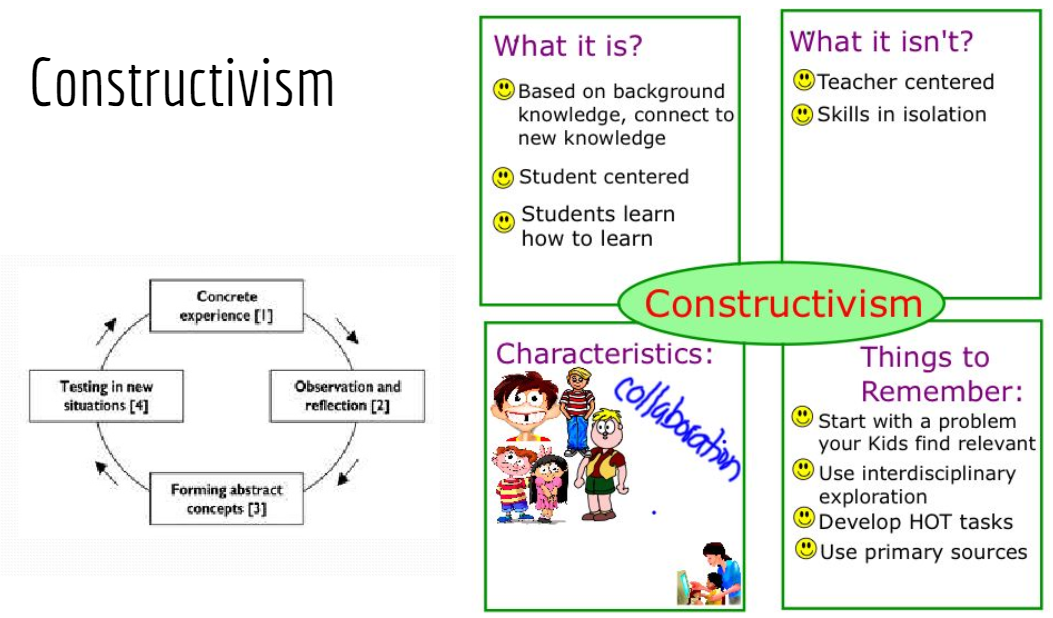 Social Learning Theory - Starting with Vygotsky’s research, this theory supports the idea that students learn within a community. The community includes peers, teachers, other adults, and home and family life as well. Discourse, talk moves, and whole-class processing strategies become critical learning strategies as a result. See the Social Learning Theory Blog for more information.  Inquiry Instructional Model - As an outgrowth of Constructivist Learning and Social Learning Theory, Dewey’s Inquiry Based Learning in the form of Guided Inquiry becomes the backbone of Phenomenal Science units. Each instructional Cycle follows a modified “Five E Approach” as proposed by Bybee. This model helps us ensure that investigations happen prior to asking students to develop concepts and that student concepts have begun forming before we introduce vocabulary or expert voice. See the Inquiry Blog for more information. 

Unpacking the StandardsThe Phenomenal Science Units were developed with a backwards design approach as described by Wiggins and McTighe. This means that the first step to understanding what must happen in a unit is to truly understand what is in the Michigan Science Standards / Next Generation Science Standards bundled in that unit. You can see the bundles of the standards in the Pacing and Alignment Guide (go to the Units page). The following resources and information are helpful in understanding the three dimensions of the standards and how they work together.
  Some further helpful resources are: Including Engineering In the blog Connecting Anchoring Phenomena with the Nature of Science and Engineering, the author has a good description of how you could use the same phenomenon to tackle both an engineering problem and a science question. Appendix I of f the NGSS explains more about the inclusion of Engineering in the standards. It gives these progressions across Elementary grades: In the units, there should be at least one engineering problem tackled in most units. Usually this will occur after the the phenomenon has been explored with scientific questions toward the end of an IC or even the end of the unit.  Three dimensional AssessmentsThe second step of backwards designing units is to develop an assessment. This give the unit its "target," and ensures that it stays aligned to the standards. Because of the three-dimensional nature of the standards, most of the unit assessments are three dimensional Performance Assessment Tasks, and some are Item Clusters. You can investigate your unit's assessments in the Evidence of Learning Section (orange charts).
How do we translate Checkbrics to points? How do we assign grades for report cards? This could be a challenge for teachers, and we’ve found that sometimes teachers who are first trying out PS really struggle with this. Here is a resource from ASCD that gives some more background on using Performance Assessments which might help. Several units incorporate pre-assessments. Formative Assessment Probes such as these and Science Formative Assessment are good resources for pre-assessment, but there are many other ways as well. Also, this section from Tools and Traits for Highly Effective Science Teaching called “Before and During the Science Lesson: Using Science Probes to Get at Student Thinking” (p. 41-44) can be a good resource. In the Phenomenal Science Units we've embedded assessment in several places, since the learning, teaching, feedback cycle is continuous. There are also several different types of assessment. The summative assessments for the unit are typically performance assessment tasks like those linked above and can be found in the Evidence of Learning section as well as at the end of the instructional cycles. Other assessment opportunities are highlighted in the Learning Plan Overview as well as in each lesson. Formative Assessment Formative Assessment is critical to teaching science using sense-making strategies. Formative assessment is a “process used by teachers and students during instruction that provides feedback to adjust ongoing teaching and learning to improve students’ achievement of intended instructional outcomes” (CCSSO, 2008, p. 3) As Furtak points out, “formative assessment is something that teachers and students can do together, every day, to monitor student learning and provide timely feedback (Shepard 2000; Trauth-Nare and Buck 2011).” (Furtak & Heredia, 2016)) This makes formative assessment and invaluable tool for teachers engaging students in making sense of science phenomena. The text box details some specific differences that come with three-dimensional formative assessments.
 Using the process outlined by Furtak, et al, helps teachers make the best use of the formative assessment process. It is important that the formative assessment used be both rigorous and responsive. Formative assessments help us answer three questions: Where are we going? Where are we now? How do we get there? Teaching science for understanding through sense-making is not a linear process, but formative assessments help us get there. (Gotwals, 2017). [Diagram from Furtak, 2017]  Where are we going is answered in the PE’s, unit goals, and learning performance statements. Using a tool like the one shown below (from Furtak, 2017) can also help teachers take students current ideas, thinking and experiences into account when considering the formative assessment goal and tool to use.   How do we elicit student understanding? There are three main methods to gather evidence of student understanding: Discourse, Written work, Student Self assessment. (Gotwals, 2017). Choosing a rich task, especially during the Pre Assessment portion of the instructional cycles can be a very productive method for understanding student thinking. Rich tasks are ones that will show what naive conceptions and explanations students are currently holding as well as give the teacher some potential leverage points about which to focus upcoming discourse and investigations. In this way, teachers can allow students to use student-generated evidence to build models, explanations and arguments toward more scientifically accepted explanations of phenomena.
The most challenging portion of formative assessment process is determining what can be learned from the results. Two main purposes for the formative assessment is to provide feedback to students and determine our next steps in instruction.
Another key challenge for teachers is determining what to be graded. Considering that the key purpose of formative assessment is to give feedback to teacher for planning and students for growth, they should be graded sparingly. Both students and teachers need to have trust in the process and be free and confident to share their thinking about their science ideas. (Gotwals, 2017. DeLeon & Allen, 2015) Using evidence is the hardest piece of the puzzle. (Gotwals, 2017) According to Gotwals the main question teachers need to ask themselves with formative assessment data / evidence: What can you productively do with that idea? Some possibilities include, adding ideas to a Class Question Board or Competing Hypotheses Board; gather evidence as a class to support or refute the idea; use the idea to scaffold small group discourse or as questions in whole class discourse. Another great option for showing student growth and learning is to keep track of student models that change over time - can have a checklist for the model and pieces that you want to see in it. (Gotwals, 2017). Furtak recommends the following tools as helpful as teachers analyze student formative assessment data   Finally as can be seen from Research Brief: The Informal Formative Assessment Cycle as a Model for Teacher Practice formative assessment can help science teachers attend to equity in the following ways:
So, with all this background, how do we use formative assessment within Phenomenal Science? There are several areas within the units to look for possible formative assessment tasks. First, in the Learning Plan Overview charts, the right-most column is dedicated to highlighting some of the formative assessment opportunities within each instructional cycle. All of the items in that column would be ones that could provide feedback to teachers and students about student understanding. Secondly, throughout the units there are embedded opportunities for Student Discourse and for Written Work. Discourse happens both in small groups and pairs and in whole class settings. Written work comes especially in the form of notebook entries, models, initial explanations and CER’s. Some instructional activities combine the two especially well such as, Summary Tables, Class Question Boards, Consensus Models or Explanations, and Investigations.  

For further ideas about formative assessments:
Science concepts are developed through multiple iterations |


 |  |  |
Summary Tables - the how and the why
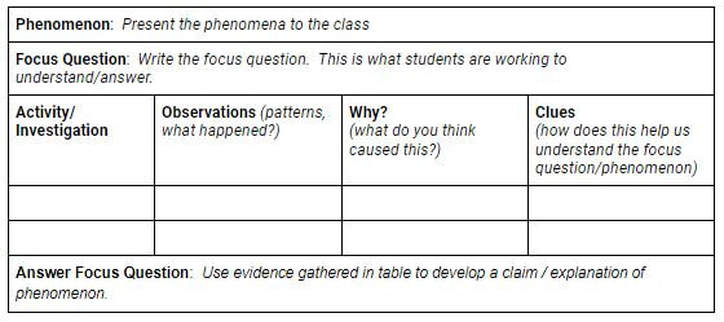
Example Summary Table set up
In science it is important that ideas/conclusions be able to change over time as new evidence is found. As in real science, our science classroom needs to allow for thinking to change/be revised as students collect new data. One of the best ways that teachers can assist students in organizing their thinking is by making use of a summary table or KLEWS Chart- a way to record activities and ideas.
A summary table can be easily adapted to meet the needs of your classroom. For example column headings can be tweaked to best fit the CCC for the instructional cycle. Other adaptations could include a column for evidence, noticings, questions, etc. Below are examples of some of the possibilities: See above for Summary Table example See below for KLEWS Chart example
4. Tips and Tricks:
There will be at least one summary table or KLEWS chart in each unit.
- The process:
- Present the phenomenon → A puzzling event that will get them engaged in the upcoming learning.
- Ask Focus Question → This is posed to the students at the beginning of each instructional cycle. It is the question that students are working to understand/answer.
- Begin investigating → This will typically be the first explore of the instructional cycle.
- Record the first investigation/activity in the summary table.
- Continue to fill in with subsequent investigations and activities
- Use evidence gathered at end to develop a claim / explanation of phenomenon
A summary table can be easily adapted to meet the needs of your classroom. For example column headings can be tweaked to best fit the CCC for the instructional cycle. Other adaptations could include a column for evidence, noticings, questions, etc. Below are examples of some of the possibilities: See above for Summary Table example See below for KLEWS Chart example
4. Tips and Tricks:
- This works best as a whole class product
- Limit number of columns to 4-5
- Try not to exceed more than 5 rows
- Written information
- Elementary level → teacher can aide in crafting wording
- Complete each row as it happens in class
There will be at least one summary table or KLEWS chart in each unit.
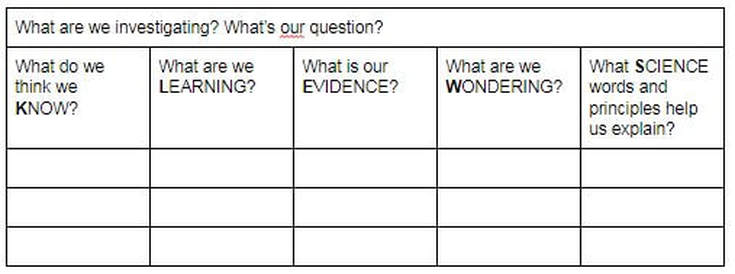
KLEWS Chart set up
Investigations
Why Use Investigations?
Do students need to do investigations? Developmentally, elementary students are still in an area of “concrete” thinking. As teachers it is our task to help them translate some of their ideas from concrete to more abstract thinking - developing some conceptual understanding of the world around them. It is very difficult to engage students with more abstract concepts if they don’t have concrete, hands-on experiences to which they can “hook” the new ideas. By starting with concrete experiences, we meet them where they are currently thinking and reasoning and can take them further in their thinking. From the concrete experiences we are building from a solid foundation of experience.
We also know that students benefit from multiple modalities of learning. Investigations and hands-on activities allow for students to learn in all 4 modalities at once: visually, auditorily, kinesthetically, and socially. This allows for a whole lot of neurons firing in the brain - building pathways and connections and strengthening them all at once.
Finally, investigations mirror the way science works in the real world. This allows students to build a deep understanding of the Science and Engineering Practices and to become masters at learning through engaging in them. It also allows them to “see” themselves as scientists or at the very least, scientific learners. It also makes real the process of collecting first hand evidence and using it to develop understanding and make shared meaning. There is no other better process than beginning with an investigation to develop that understanding. This first hand evidence is also the best (only?) way to really get students to shift their thinking from stubborn naive conceptions. When confronting this evidence in light of misconceptions, cognitive disequilibrium ensues, and students are forced to reconcile the two ideas and build meaning.
How Do We Use Investigations With Students?
Taking on investigations with your students can be very daunting. However, it doesn’t have to be! The first thing to know is that there isn’t a set right way to “do” investigations. The main goal is to have students gather data (evidence) that will allow them to build understanding of a phenomenon.
When first starting investigations with your students you may want to follow a more “gradual release” sort of model. So, to start with you might do several investigations together as a whole class. In later cycles, you might do parts of the investigation whole-class and allow groups to conduct parts together. Eventually, student groups and possibly even individuals will be empowered to conduct their own investigations from start to finish. Of course, this will also vary by grade-level and will need to be adjusted according to the amounts of materials you have available. Ideally, we work to have students engaging with the Science and Engineering Practices to conduct their own investigations as often as possible.
Here is a general process to follow in guiding your students to do investigations:
Withing Phenomenal Science Units you will find at least one hands-on investigation included in every instructional cycle. The Phenomenal Science project strives to keep materials simple for busy teachers. As a result, in planning materials we followed the GEICO Rule: “15 minutes or less” from items in a typical classroom or perhaps household with only the occasional trip to local store.
Do students need to do investigations? Developmentally, elementary students are still in an area of “concrete” thinking. As teachers it is our task to help them translate some of their ideas from concrete to more abstract thinking - developing some conceptual understanding of the world around them. It is very difficult to engage students with more abstract concepts if they don’t have concrete, hands-on experiences to which they can “hook” the new ideas. By starting with concrete experiences, we meet them where they are currently thinking and reasoning and can take them further in their thinking. From the concrete experiences we are building from a solid foundation of experience.
We also know that students benefit from multiple modalities of learning. Investigations and hands-on activities allow for students to learn in all 4 modalities at once: visually, auditorily, kinesthetically, and socially. This allows for a whole lot of neurons firing in the brain - building pathways and connections and strengthening them all at once.
Finally, investigations mirror the way science works in the real world. This allows students to build a deep understanding of the Science and Engineering Practices and to become masters at learning through engaging in them. It also allows them to “see” themselves as scientists or at the very least, scientific learners. It also makes real the process of collecting first hand evidence and using it to develop understanding and make shared meaning. There is no other better process than beginning with an investigation to develop that understanding. This first hand evidence is also the best (only?) way to really get students to shift their thinking from stubborn naive conceptions. When confronting this evidence in light of misconceptions, cognitive disequilibrium ensues, and students are forced to reconcile the two ideas and build meaning.
How Do We Use Investigations With Students?
Taking on investigations with your students can be very daunting. However, it doesn’t have to be! The first thing to know is that there isn’t a set right way to “do” investigations. The main goal is to have students gather data (evidence) that will allow them to build understanding of a phenomenon.
When first starting investigations with your students you may want to follow a more “gradual release” sort of model. So, to start with you might do several investigations together as a whole class. In later cycles, you might do parts of the investigation whole-class and allow groups to conduct parts together. Eventually, student groups and possibly even individuals will be empowered to conduct their own investigations from start to finish. Of course, this will also vary by grade-level and will need to be adjusted according to the amounts of materials you have available. Ideally, we work to have students engaging with the Science and Engineering Practices to conduct their own investigations as often as possible.
Here is a general process to follow in guiding your students to do investigations:
- Lead with a question
- This can be the focus question or investigation question from your lesson or one that students develop from Summary Table or a Driving Question Board
- Investigate to find the answer
- Use think alouds to develop procedures together
- Be flexible in student choice of methods to investigate when possible
- Allow students to develop their procedure as often as can be
- Will need to give plenty of guidance and scaffolding to get students adept at this.
- May start with thinking through a procedure that is given, then allow them to develop whole class short procedures, and so on.
- Guide students to develop methods for recording and tracking data
- Will need to give plenty of guidance and scaffolding to get students adept at this.
- May start with thinking through a procedure that is given, then allow them to develop whole class short procedures, and so on.
- Follow up with plenty of processing opportunities to make meaning of the investigation
- In summary, some key components of a quality investigation include: students enabled to get hands on materials that help them make meaning; investigations should be student led as much as possible; engage students in Practices to make meaning and keeps students wondering and making meaning.
Withing Phenomenal Science Units you will find at least one hands-on investigation included in every instructional cycle. The Phenomenal Science project strives to keep materials simple for busy teachers. As a result, in planning materials we followed the GEICO Rule: “15 minutes or less” from items in a typical classroom or perhaps household with only the occasional trip to local store.
 |  |  |

Scientific Method vs. Methods of Scientists

AKA how science gets done
Try this Formative Assessment Probe by Page Keely (Doing Science). . .
Does it surprise you that “Tamara?” is the most accurate view of how scientists “do” science? In spite what we all learned in school as the scientific method, there is no one beginning to end process that scientists follow. As teachers we need to be cautious about presenting the scientific method as a step-by-step linear process.
Try another Formative Assessment Probe by Page Keely (Hypothesis). . . (at bottom of text)
The best choices are A, B, G, K, L and M. Why are these options surprising to you? They tend to go against how we learned about hypotheses in our own school experiences. However, research scientists rarely even use hypotheses. The main reason for this is because it tends to skew their view of the data they gather. Just like our students, it is human nature to want to be “right” and so to state an hypothesis puts them in danger of not being objective any longer.
Watch this video about How Science Works. . . As you can see, the scientists definitely do not follow a linear process! What implications do you think this might have for how we might present the “scientific method” to students?
As one can see from the video, scientists must be adept at using many different skills, practices, processes and methods. They also need to be able to choose which one to employ in any given juncture in the process. We need to build this same sort of skill set in our students. Engaging students in the eight Science and Engineering Practices builds toward this. Also, we need to help student think through the steps they might follow for an investigation or experiment. Working through the process as a whole class we can model the thinking process of choosing a next step to continue to build our understanding of a phenomenon. Check out “I Taught My Students How to Do the Scientific Method and They Are Good at Using It!” from Tools and Traits for Highly Effective Science Teaching (p. 13-14) for some further ideas about what this looks like.
If students have this sort of thinking and metacognition modeled for them through think-alouds and whole-class investigation, eventually we can shift their ability to enable them to choose appropriate next steps for their own investigations as well. This might look like posting the following chart on the wall and using it to help guide our choice of strategies as we endeavor to build understanding.
- Scientific Method is not a linear process.
- Need to teach students that Scientists need to be adept at using many methods
- Need to give students opportunities to choose which methods they need to employ to investigate a phenomenon or question often
- Resources: (CAS “How does science work” stuff)

Anchoring Phenomena
It is important to engage students at the beginning of a unit by presenting them with an observable and puzzling event, or a phenomenon. Often the events are so puzzling for students that it causes some cognitive disequilibrium which students will strive to work through until they figure it out. The phenomenon will be the context for their learning while also serving to anchor the students around a shared experience that they can work to understand over the course of the unit. After the anchoring phenomenon is presented it should not be forgotten. It is essential that the students revisit the anchoring phenomenon several times throughout the unit as they work to understand the puzzling event via investigations, readings, and activities. It takes some perseverance to build understanding around phenomena - they are not meant to be figured out in a single lesson.

When puzzling real observable events are presented to students, it is usually engaging for students. This presents the teacher with an excellent opportunity to elicit students’ current understanding which can be used for directing the inquiry cycle of instruction. For more ideas on eliciting students initial thinking read “Engagement through Elicitation is Key to Beginning Scientific Inquiry” from Tools and Traits for Highly Effective Science Teaching (p. 40) As a follow up check out “Helping Student Change ‘Why’ Questions Into ‘How’ Questions to Make Testable Questions” from p. 50-51 of the same text.
A case for using anchoring phenomena:
A case for using anchoring phenomena:

Using Anchoring Phenomenon with the 5E model

Tips for using Phenomena
In the Phenomenal Science Units, there is a phenomenon for each instructional cycle within a unit. The phenomenon will be revisited several times throughout the instructional cycle. Students should develop their explanation of the phenomenon by the end of the cycle but sometimes sooner. The same phenomenon can be used for the cycle assessment, or a different related one. A summary table is a great tool often used to track understanding towards the phenomenon / focus question.
Additional information about using phenomena can be found at:
- Focus questions should be linked to Phenomena
- Can explain phenomena at different points in the IC
- If explaining earlier then other related pieces need to still make relationship explicit
- If explaining later then can intro related ideas in the middle of IC
- Below is a graphic that helps show how the phenomena can be revisited during a instructional cycle (this should be done several times with an IC)
In the Phenomenal Science Units, there is a phenomenon for each instructional cycle within a unit. The phenomenon will be revisited several times throughout the instructional cycle. Students should develop their explanation of the phenomenon by the end of the cycle but sometimes sooner. The same phenomenon can be used for the cycle assessment, or a different related one. A summary table is a great tool often used to track understanding towards the phenomenon / focus question.
Additional information about using phenomena can be found at:
- Planning for Engagement (pages 3-7)
- Stem Teaching Tool #28
- Stem Teaching Tool #42
- Criteria for Selecting Phenomena
- Criteria for Evaluating Phenomena


Integration
Every elementary educator knows that classroom time is at a premium and in recent years there has been an overwhelming emphasis on Reading and Math. As a result it is imperative that our science curriculum and instruction are mindfully integrated with ELA, Math, and even Social Studies. According to the Michigan Department of Education, SCIENCE is actually the perfect vehicle to drive this integration and that the Michigan ELA Standards “cannot be fully addressed outside of the context of science education. . . . Young children who participate in learning science are more likely to interpret and learn with challenging text, acquire rich vocabulary and language, write for a broader range of purposes, and build evidence-based argument to communicate with others.” from Supporting Early Literacy Development and Science Instruction. As can be seen in the MSS/NGSS standards themselves, connections are made to Michigan Mathematics Standards as well. Connections among the three are especially prevalent in the Practices of each as can be seen in this venn diagram. Research also supports the idea that students need content experiences to fully understand what they read as can be seen in the video Teaching Content is Teaching Reading.
English Language Arts
Many of the Key Instructional Strategies embedded in the Phenomenal Science Units, such as Science Discourse, Collaborative Groups, Modeling, Summary Tables, Notebooking, Argument and Explanations, naturally integrate many key aspects of literacy and language arts. As these come up throughout the units, look for the standards connections noted there in the Why column. The units also strive to integrate a great deal of informational text such as those found in MeL ebooks, book flix, Britannica encyclopedia, World Book encyclopedia and articles. Other text sources include: NewsELA, YoungZine, ReadWorks, Article of the Week and Archive AoW. Some other good ideas about integration between Science and ELA can be found in Exploring the Science Framework which digs into the practice of Obtaining, Evaluating and Communicating Information. The Michigan English Language Arts Standards are helpful for comparison. MeL List is also a helpful resource. For practical suggestions around developing literacy through science instruction, read Linking Literacy Development and Science chapter from Tools and Traits for Highly Effective Science Teaching (p. 27 - 35)
Mathematics
There is a great connection between the Mathematical Practice and the Science and Engineering Practices. Exploring the Science Framework: Making Connections in Math gives some great examples about how we can be more intentional about making this integration obvious and explicit. As noted by Edutopia author Ben Johnson in How to Creatively Integrate Science and Math, “Ultimately, as another study reported, the students' increased conceptual understanding of math and science is the greatest benefit of math and science teacher collaboration. Conceptual understanding means the students know the bigger picture of why things work in math and science, not just how to make them work.” Further, cited on the site Integrating Science and Math, Research indicates that an integrated approach to learning aligns with the way the brain naturally processes and internalizes new information. Since mathematics and science are integrated in the world outside the classroom, and technology has become a natural extension of this integration, it seems only logical that these areas are studied together inside the classroom.” This same site is a great resource for more information and strategies. Refer to the Michigan Mathematics Standards for further connections.
Social Studies
It has also been noted that within the units there are many connections to the Michigan Social Studies standards. With classroom time so short, we must take advantage of all the connections we can make.
Technology
Students need to be proficient at using and evaluating technology resources. Consider this article, Five Reasons Why Tech Matters, to further understand the need for students to experience technology. There are many ways to engage students in the use of technology within the Phenomenal Science units. Refer to the ISTE Technology Standards for connections.
 |  |
Exploration Stations are also sometimes called Science Tables and are like centers or stations, that students can visit during an appropriate time to learn and do science activities. They help increase opportunities for students to build and extend understanding. They become another iteration of the content in a different mode and method.
- Example of 1st grade Science Table
- Other Science Table Ideas

Photo Courtesy of Erin Davis, PS Teacher Leader and Coach
Exploration Stations are a great way for students to build independence and exercise more of their own choice and voice. Because constructivist, inquiry-based classrooms invite some cognitive disequilibrium, Exploration Stations are one way for helping students own this uncertainty and take charge of working toward deeper understanding as can be seen in this Education Leadership article, Inviting Uncertainty into the Classroom, which states that allowing students to grapple with open-ended problems helps students respond well to uncertainty. Exploration Stations can be both an invitation to wrestle with those problems and a resource for finding ideas when students might be stuck. Using Learning Centers suggests that well managed centers can actually lead to easier classroom management and fewer discipline issues. The Scholastic article Learning Centers, Part 1: Why They’re Important makes the case that centers are very developmentally appropriate especially in early elementary. Science in Early Childhood Classrooms: Content and Process presents a research-based case for using centers and some good examples of their use.

Photo Courtesy of Erin Davis, PS Teacher Leader and Coach
Several resources for setting up Exploration Stations include:
Explanatory and Argumentative Speaking and Writing
While a C-E-R Strategy is often used interchangeably in science for both Explanatory and Argumentative Speaking and Writing in order to align well with the Michigan ELA Standards as well. Consider this article, In Elementary School Science, What's at Stake When We Call an 'Argument' an 'Opinion'? as an example of how important it can be to be clear about this alignment for both teachers and students. In this portion we have included information about both that will hopefully clarify the differences and how they work together.
Explanatory Speaking and Writing
When we work with students to develop Explanatory speaking and writing for science, we always work to explain a phenomenon or investigation. Research from secondary sources can also be included. Our explanation, whether written or spoken, should describe events or results and should answer either “how” or “why” and perhaps both. Examples of explanatory writing might include: How-to Guide, Cause and Effect, Magazine or Newspaper Article, Brochure, Infographic, Public Service Announcements, and Documentaries. Here are some examples to consider. Explanatory writing works especially well when having students dig into the Crosscutting Concepts of Cause and Effect, Patterns, Structure and Function or Stability and Change.

In getting students to develop this type of thinking, speaking and writing, a gradual release model is helpful. Teachers may want to begin by conducting “Think-alouds” in which the teacher begins by thinking through what the class has observed and beginning to develop an explanation for an investigation or phenomena. Developing sentences and even paragraphs together as a whole class is a good way to practice. Having students begin to practice by speaking their explanatory thinking in pairs or small groups is also a critical step. Pairs or groups may then be ready to write explanatory thinking together. Finally, students might be expected to craft their own explanatory sentences or paragraphs would happen after the different levels of practice. Of course, this will look different and take different lengths of time depending on the grade level. (see chart below) When we are scoring explanatory writing we should keep in mind both science and ELA. In Appendix F of the NGSS, there is a progression (shown in box at right) for the practice of Explanation to consider on p. 11. This can be compared and used in conjuntion with these rubrics that are aligned to Common Core State Standards for ELA and this rubric from Read, Write, Think within this example lesson on scientific explanation for K-2.
Explanatory and Argumentative Speaking and Writing (continued from part 1)
Argumentative Speaking and Writing
In Argument writing and speaking, on the other hand, students should make a claim about a phenomena, investigation, or current situation. Using a Claims-Evidence-Reasoning structure is especially helpful in developing Argument structured thinking with students. When using this structure in science, students should gather data (evidence) first. After analysis, students can determine what case the evidence seems to make for them. Crafting a statement that answers the focus question and is supported by their evidence becomes a Claim. Finally, older students can add some Reasoning statements which explain how the Evidence supports their Claim statement. So in writing an Argument, the structure follows the order of 1) Claim, 2) Evidence, 3) Reasoning, but in developing the Argument the order is 1) Evidence, 2) Reasoning, 3) Claim. When students are engaging in the practices of Investigation and Data Analysis, Argument speaking and writing is a natural fit.
There are many strategies which help students engage in Argument thinking, writing and speaking. This site, Argument Driven Inquiry outlines an 8-Step Process and The Core of Science Relating Ideas and Evidence, outlines how both students and scientists craft arguments from investigations. Some further strategies can be found in this resource called Scientific Argumentation and these examples. This resource is aimed at high school students and teachers but helps understand the ideas of Claim, Evidence and Reasoning. One important skill includes helping students craft arguments from texts they read, and this article is a good resource to consider for this process. Generally, a gradual release process similar to that outlined for Explanatory writing should be followed. When students are ready for a more formal written Explanation or Argument, working with them to develop an “indicator list” or “gotta-have-it checklist” is a helpful strategy. This can become very helpful in scoring the writing. Just as with Explanation, we need to keep in mind what we know about the Argument practice from Appendix F, p. 12 and at left. This rubric is a good resource for more ideas on scoring Argument writing as aligned with ELA.
Here is a good summary comparison of Explanatory and Argument speaking and writing: in an article from NSTA which does a good job of describing each.


Notebooking
Notebooking is a powerful strategy that enables students to develop a deep understanding of science content while also supporting and reinforcing language skills. Notebooks also provide a mechanism for teachers to tailor instruction based on formatively assess student learning. Feedback is a critical component of growth and notebooks allow both the teacher and peers to give individualized comments that push the learner to dig deeper, clarify, and/or add on to their learning. For a brief introduction to notebooking, check out this section “Science Notebooks: a Growing Strategy for Linking Science and Writing” from Tools and Traits for Highly Effective Science Teaching (p. 51-58)
There are many ways to effectively implement the use of a science notebook into your classroom. Some options include a spiral notebook, a journal, a digital notebook, a journal folder, or lined/computer paper stapled together. When considering how to best utilize this strategy in your classroom it is best think about the grade level, writing and reading abilities, and organizational skills that the students already possess. Additional information for implementation of a science notebook can be found here.

Notebooks can be used daily as students work through processing information. Entry types should be chosen carefully to meet the requirements of the lessons outcomes. This document includes several ideas for potential notebook entries.

Still have questions, that is understandable! Use the following resource to uncover even more information about the tips and tricks of science notebooks.

Examples of notebooks can be found within this google slide presentation. Some good tips, tricks and examples are in this article titled Five Good Reasons for Using Notebooks.
 |  |

How is the development of Crosscutting Concepts cultivated with student notebooking? How does notebooking impact student engagement with Science and Engineering practices? Click on the image to see all 3 dimensions.
Author
Phenomenal Science Leadership Team
Archives
February 2022
January 2022
November 2021
May 2021
March 2021
February 2021
November 2020
July 2020
August 2017
July 2017
 RSS Feed
